Sabre Saw vs Jigsaw Comparison
Contents
- Our Top Jigsaws Are:
- 1. Bosch JS470E Jigsaw: Top Pick
- 2. PORTER-CABLE PC600JS Jigsaw
- 3. Makita XVJ03Z 18V LXT Lithium-Ion Cordless Jigsaw
- Our Top Sabre Saws Are:
- 1. Skil RS58020: First Choice
- 2. Metabo 602269850 18 LTX Bare
- 3. Blue Ridge BR2801U
- Sabre saw vs Jigsaw: What are the Main Differences?
- Buying Guide
- Power
- Durability
- Brand
- Ease Of Use
- Final Thoughts
- Sources
In carpentry, having the right saw matters. Jigsaws and sabre saws are two of the most common handheld saws, but which one should you buy?
The names are confusing. In North America, "saber saw" is an older name for the jigsaw. In the UK and Europe, "sabre saw" usually means a reciprocating saw. In this post, we use "sabre saw" in the second sense: a reciprocating saw.
To help you choose, we compare their design, uses, power and features. Read on to find out which suits your workshop.
OUR TOP PICK
The Bosch JS470E Jigsaw is our top choice for its strong motor, orbital action and solid build.
Our Top Jigsaws Are:
| Product | Details | ||
|---|---|---|---|
| 1. Bosch JS470E Jigsaw | 1. Bosch JS470E Jigsaw Top Pick | - Weight: 5.6 pounds - Dimensions: 14 x 4 x 8.4 inches - Power source: Corded electric - Warranty: 1-year limited | Check Current Price |
| 2. PORTER-CABLE PC600JS Jigsaw | 2. PORTER-CABLE PC600JS Jigsaw | - Motor: 6 amps - Power source: Corded electric - Warranty: Three years | Check Current Price |
| 3. Makita XVJ03Z 18V LXT Lithium-Ion Cordless Jigsaw | 3. Makita XVJ03Z 18V LXT Lithium-Ion Cordless Jigsaw | - Up to 2,600 strokes per minute - Power source: 18V LXT battery - Warranty: Three years | Check Current Price |
1. Bosch JS470E Jigsaw: Top Pick
The Bosch JS470E is our top pick in the jigsaw category. It is powerful, well built and easy to control.
According to Bosch's JS470E product page, it has a 7.0-amp motor, variable speed up to 3,100 strokes per minute, and Constant Response circuitry that keeps the speed steady under load.
Four orbital-action settings let you choose between a smooth, straight cut and a faster, more aggressive one. That makes it useful across a wide range of materials.
Accuracy is its strong point. A precision-machined plunging system and low-vibration design help the blade track your line, and the die-cast aluminum footplate stays flat on the work.
The blade change is tool-free, with an ejection lever so you don't touch a hot blade. It takes T-shank blades only.
Specs
- Weight: 5.6 pounds
- Dimensions: 14 x 4 x 8.4 inches
- Power source: Corded electric
- Warranty: 1-year limited
Pros
- Designed to last
- Dust blower with an on/off switch keeps the line visible
- Changing blade is easy and fast
- You can use it on many projects
Cons
- Pricey
- Does not accept U-shank blades
2. PORTER-CABLE PC600JS Jigsaw
The Porter-Cable PC600JS is a budget-friendly corded jigsaw with a comfortable design and a solid motor.
It runs on a 6-amp motor, which is strong enough for most workshop and job site cuts in wood and sheet goods.
The compact body keeps your hand close to the workpiece for better control. The rubberized D-handle gives a firm grip, and you can steady the front of the tool with your other hand.
Specs
- Motor: 6 amps
- Power source: Corded electric
- Warranty: Three years
Pros
- Its speed dial makes it ideal for different projects
- LED light improves visibility of the cut line
- A balanced and easy to use design
- Comes with a warranty of three years
Cons
- Cannot be used without electricity
3. Makita XVJ03Z 18V LXT Lithium-Ion Cordless Jigsaw
In third place is the Makita XVJ03Z, a cordless jigsaw that suits both carpenters and DIYers. It handles projects from furniture parts to trim and sheet goods.
It runs on Makita's 18V LXT batteries and delivers up to 2,600 strokes per minute.
A two-finger variable-speed trigger lets you control blade speed, so you can slow down for curves and harder materials.
Specs
- Up to 2,600 strokes per minute
- Power source: 18V LXT Li-ion batteries
- Warranty: Three years
Pros
- Star Protection controls guard against overloading, over-discharging and overheating
- Comes with a long warranty of three years
- Designed with a tool-less changing system
- Designed with an ergonomic handle
- Strong and durable
Cons
- Sold without a charger and battery
- Long sessions need a spare battery
OUR TOP PICK
On sabre (reciprocating) saws, our first choice is this Skil RS58020. It is compact, cordless and well suited to rough cuts and light demolition.
Our Top Sabre Saws Are:
| Product | Details | ||
|---|---|---|---|
| 1. Skil RS58020 | 1. Skil RS58020 Top Pick | - Weight: 5.21 pounds - Dimensions: 12.8 x 2.8 x 5.5 inches - Power source: 12V battery | Check Current Price |
| 2. Metabo 602269850 18 LTX Bare | 2. Metabo 602269850 18 LTX Bare | - Weight: 4.53 pounds - Dimensions: 16.1 x 3.4 x 7.1 inches - Power source: 18V battery | Check Current Price |
| 3. Blue Ridge BR2801U | 3. Blue Ridge BR2801U | - Weight: 8.29 pounds - Dimensions: 19.6 x 7.8 x 3.9 inches - Warranty description: 1-year standard warranty | Check Current Price |
1. Skil RS58020: First Choice
This compact reciprocating saw is our first choice in the sabre saw category. It suits pruning, cutting pipe and light demolition, especially away from an outlet.
It is sold as a kit with SKIL's PWRCore 12 battery system, so you can work where there is no power.
The saw is compact and light, with a brushless motor that fits into tight spaces. A pivoting shoe keeps the saw steady against the work for smoother cuts.
Reciprocating saw blades wear quickly, so the tool-free blade change is a real convenience. You can swap blades in seconds without a wrench.
Specs
- Weight: 5.21 pounds
- Dimensions: 12.8 x 2.8 x 5.5 inches
- Power source: 12V battery
Pros
- Brushless motor makes good use of each charge
- Ideal for off-workshop tasks
- Compact and light
- Designed to last
- Cheap
Cons
- The battery pack can get in the way in tight spots
- 12V power is best for light to medium cuts
2. Metabo 602269850 18 LTX Bare
The Metabo 602269850 18 LTX takes second place for its compact, rugged build.
This cordless 18V sabre saw handles pruning, plumbing and demolition cuts. Metabo is a long-established German tool maker that is better known in Europe than in the U.S.
It is light and compact for a reciprocating saw, which makes overhead and one-handed cuts easier to control.
It is sold as a bare tool, so you need a Metabo 18V battery and charger.
Specs
- Weight: 4.53 pounds
- Dimensions: 16.1 x 3.4 x 7.1 inches
- Power source: Battery-powered
Pros
- Compact and light
- Easy to use, even for newbies
- Handles demolition and pruning cuts
- Affordable
Cons
- Battery and charger sold separately
3. Blue Ridge BR2801U
The Blue Ridge BR2801U is a budget sabre saw from Blue Ridge aimed at DIY demolition and pruning jobs. Check the listing for its current power source and speed before you buy.
The main handle sits at the back of the tool, and you can grip the front housing with your other hand for better control. A pivoting shoe gives a larger contact area against the work for stability.
Blade changes are tool-free, so you can swap blades in seconds.
Specs
- Weight: 8.29 pounds
- Dimensions: 19.6 x 7.8 x 3.9 inches
- Warranty description: 1-year standard warranty
Pros
- Budget-friendly
- Easy to use on different cutting projects
- Built to last
Cons
- Not suited to curves or precise cuts
Sabre saw vs Jigsaw: What are the Main Differences?
It's easy to see why sabre saws and jigsaws get confused. Both are handheld saws with a blade that moves back and forth. So what exactly is the difference?
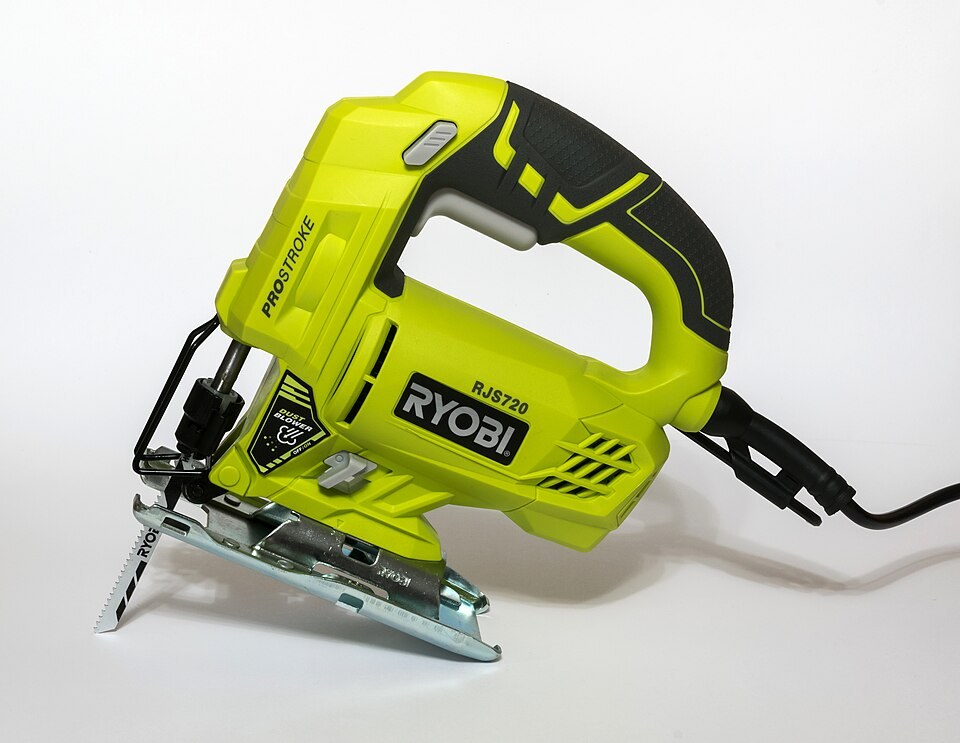
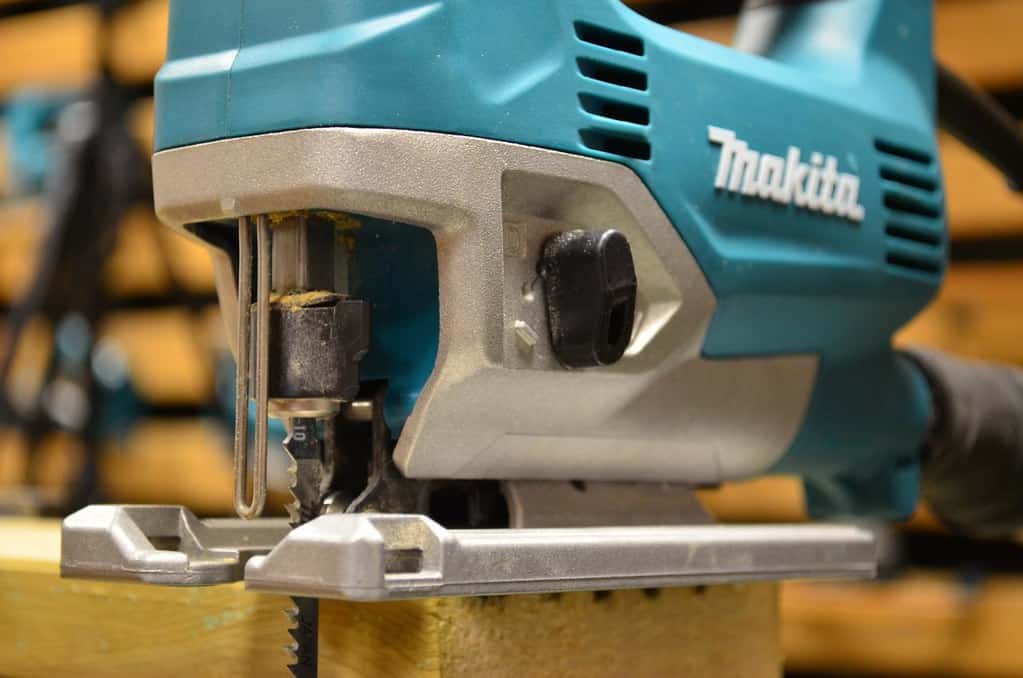
A jigsaw holds a short, narrow blade that points straight down from the tool. A flat base plate (shoe) rests on the workpiece, which keeps the blade square and lets you follow curves and lines accurately.
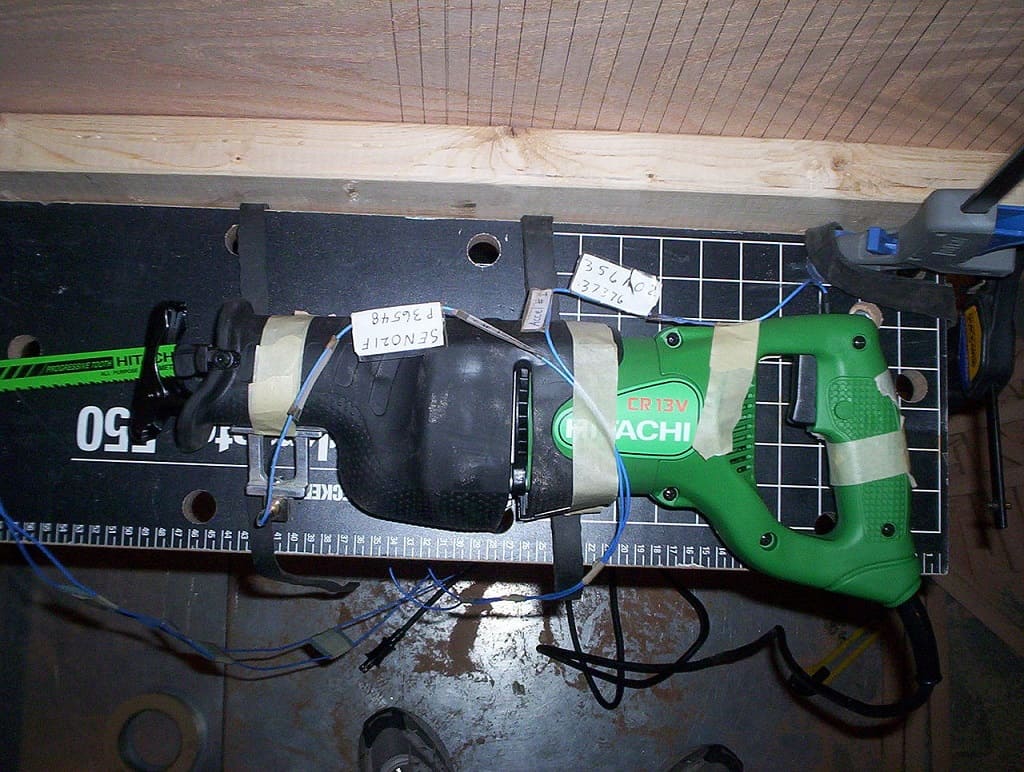
A sabre (reciprocating) saw holds a longer, stiffer blade that points forward from the front of the tool. It has only a small pivoting shoe that you press against the work, so it is harder to guide precisely.
That makes it a poor choice for accurate cuts. It is built for rough, fast cuts where accuracy doesn't matter: demolition, pruning, and cutting through nails, pipe and studs.
OSHA's handheld saw guidance applies to both: wear eye and face protection, use the right blade for the material, and keep blades sharp.
Buying Guide
Now that you know the difference between jigsaws and sabre saws, here is what to look for in either one.
Power
A stronger motor lets you cut thicker and harder material without bogging down.
If you have a lot of cutting to do, in the workshop or on job sites, choose a more powerful model.
With a cordless tool, keep a backup battery charged so you don't get stuck mid-job.
Durability
Jigsaws and sabre saws are investments you should expect to use for years, so look for solid construction.
Check for spare parts availability and the manufacturer's warranty as indicators of durability.
Brand
Established brands usually offer better warranties, parts and service. Brands to consider include Makita, Skil, Blue Ridge and Porter-Cable.
Ease Of Use
If you are new to woodworking, choose a saw that is easy to control. Look for a comfortable grip and good vibration control.
These features help you work longer without fatigue. A tool-free blade change also saves time.
Final Thoughts
In this sabre saw vs jigsaw comparison, the jigsaw comes out as the better fit for most woodworkers. It is compact and handles a wide variety of cuts. Sabre saws have their place too, especially for demolition and rough cuts.
Whether you are a professional or a DIYer, a jigsaw is usually the first one to buy for woodworking. Add a sabre saw later if you do remodeling or demolition work.
Of the saws in this post, our first pick is this Bosch JS470E Jigsaw. It is strong, compact and easy to control.