How to Tell if Your Wood is Seasoned for Woodworking
Different woods dry at different rates. If you have green wood that you want to use for woodworking, you need to know if it has seasoned enough to be useful.
Visual clues like end checks, lighter weight and a hollow sound when two boards knock together suggest wood is drying, but they can’t tell you if it’s dry enough for furniture. For indoor projects, the USDA Wood Handbook recommends an average moisture content of about 8% in most of the U.S., about 6% in the dry Southwest and about 11% in damp, warm coastal areas.
The best way to tell if your wood is seasoned enough for woodworking is to use a moisture meter.
How Does a Moisture Meter Work?
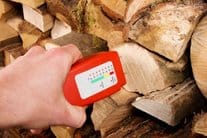
A moisture meter gives you a quick reading of your wood’s moisture content. There are two general types: pin-type (resistance) meters and pinless (dielectric) meters.
Pin-type meters require you to drive two small pins into the wood, which leaves tiny holes, so test on a hidden face or an offcut. Because the reading comes from the depth of the pins, they’re useful for checking wetter wood near a board’s core. Drive them about one-fifth to one-fourth of the board’s thickness for an average reading.
Pinless meters can scan large areas of wood very quickly without marking it. You press the sensor plate flat, activate the meter, and get a reading in a couple of seconds.
Pinless meters need a flat surface, so they don’t work well on rounded wood. Their readings are dominated by the wood near the surface, so on a thick board with a wet core they may read low. Both types need a species setting for accurate results.
Delmhorst Instrument Company has a fantastic article that lets you know which kind of moisture meter is right for you.
Knowing Your Oven Dry Weight for Comparison
The oven-dry method is the most accurate way to measure moisture content, and you can use it to check your meter. Use a small sample cut at least 20 inches from the end of a board, since ends dry faster.
- Weigh a sample of your wood. Record this as your initial weight.
- Set your oven between 214°F and 221°F (about 217°F is ideal). Don’t leave it unattended.
- Dry the sample for about 3 hours. Weigh the wood again and record the weight.
- Repeat the process until the weight stops changing between weighings. A 1-inch-long cross section of a board usually takes 12 to 48 hours.
- Then calculate the moisture content with this formula from the USDA Wood Handbook: (initial weight – oven dry weight) / oven dry weight × 100
You don’t need bone-dry wood for woodworking. Instead, aim for wood that matches the moisture content it will reach in service, so it won’t shrink, crack or warp after you build with it. Following these steps tells you when your wood is ready to be worked.
Sources
- Wood Handbook, Chapter 13: Drying and Control of Moisture Content and Dimensional Changes, USDA Forest Products Laboratory
- Pin or Pinless Moisture Meters, Delmhorst Instrument Co.