Best Compact Router Reviews: Our Favorite Small Tools To Use
Contents
- Best Compact Router Reviews
- 1. Bosch Colt Electronic Variable Speed Palm Router
- 2. Dewalt DWP611 Variable Speed Compact Router
- 3. Makita RT0701 Compact Router
- 4. Enertwist Variable Speed Soft Start Palm Router Kit
- 5. Makita XTR01Z Brushless Cordless Compact Router
- The Verdict: Which Compact Router Should You Get?
- Router Safety Basics
- Conclusion
- Sources
The best woodworking tools do not always come in big packages. Sometimes, they are as small and portable as a compact router. Don't underestimate it: a compact router cuts decorative edges, trims edging and laminate flush, cleans up uneven edges, and cuts small joinery profiles. Here are five we recommend, plus basic safety tips.
Best Compact Router Reviews
You absolutely can’t go wrong with these compact routers:
- Bosch Colt Electronic Variable Speed Palm Router
- Dewalt DWP611 Variable Speed Compact Router
- Makita RT0701 Compact Router
- Enertwist Variable Speed Soft Start Palm Router Kit
- Makita XTR01Z Brushless Cordless Compact Router
Here are the things you should know about these compact routers:
1. Bosch Colt Electronic Variable Speed Palm Router
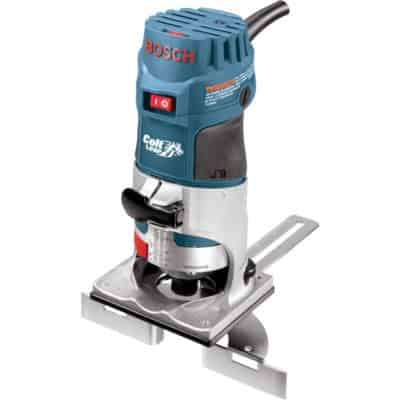
The Bosch Colt has a 1 HP, 5.6-amp motor and a variable speed range of 16,000 to 35,000 RPM, set with a dial on top of the motor.
Its Constant Response circuitry holds the speed you set as the load changes. A soft start reduces the jolt when you switch it on.
Pros:
The aluminum base is durable.
Its depth adjustment system is one of the best out there. You can do both micro and macro adjustments, to get the precise depth you are looking for.
Maneuvering this tool is easier. There are finger pockets that provide support to your fingers while using it. You get better control over it, especially when you are trimming down edges.
Adjusting the motor is easier. It has a clamp system that makes quick work of moving the motor from one base to another.
It fits the palm well.
A shaft lock and wrench make bit changes simple. Unplug the router first.
The angled cord exit helps keep the cord out of the way.
Setup is fast and easy.
Cons:
There were those who wished the base is clear, so they can see their work area better.
2. Dewalt DWP611 Variable Speed Compact Router
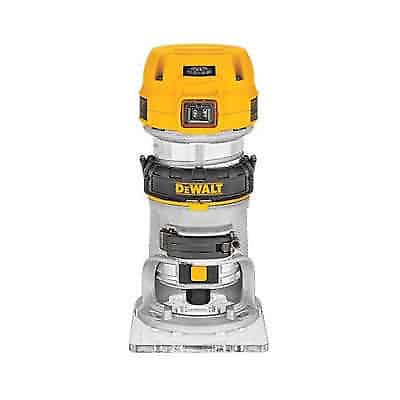
With a slightly stronger 1-1/4 HP motor, this may suit tougher jobs a little better than the Colt. Its variable speed runs from 16,000 to 27,000 RPM.
It is light and easy to carry between workstations. It has a soft start, a depth adjustment ring, a clear sub-base, and dual LEDs to light the work.
Pros:
True to its purpose, it is a compact router that you can use with just one hand. It is also lightweight enough to bring with you no matter where you go.
The manufacturer includes a 3-year limited warranty with your purchase.
The built-in LED lights are a nifty feature. You can see what you are working on better.
It takes 1/4-inch shank bits. Keep the collet clean and fully tightened for secure bit contact compared to other routers of this size, which also keeps vibration down.
It has a reputation for holding up well to heavy use.
Cons:
Some said that for trimming it is slightly big. It is still easy to maneuver though but if you are used to a smaller router for trimming, you might find this a bit clunky.
3. Makita RT0701 Compact Router
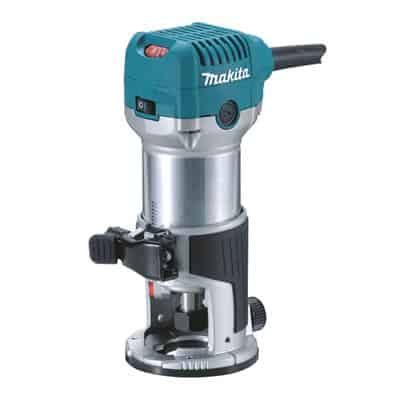
This Makita has the same 1-1/4 HP rating as the DEWALT in a compact body. Its variable speed dial runs from 10,000 to 30,000 RPM, a wider low-speed range that helps with large-diameter bits. Electronic speed control keeps the speed steady under load.
It is double insulated, which protects you from electric shock; it does not keep dust out. The aluminum motor housing is durable, and it weighs about 3.9 pounds.
Pros:
It is durable, with an aluminum motor housing.
It features a shaft lock system that makes way for more seamless bit changes.
The design is highly ergonomic. You can hold and maneuver it with one hand only. It fits palms perfectly as well.
The rack-and-pinion depth adjustment system is one of the best. It allows you to make more accurate adjustments in depth.
It has a 1-year warranty.
Makita sells it as a bare router with a fixed base or in kits that add a plunge base and other bases, so check which version you are buying.
It is easy to set up.
The body is also very compact. It isn’t at all bulky like some compact routers.
Cons:
It is lacking in an adapter to use the basic template guides out there.
4. Enertwist Variable Speed Soft Start Palm Router Kit
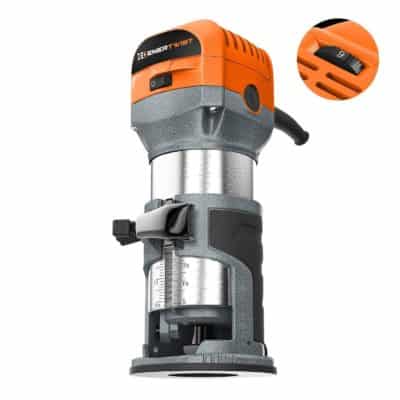
This lesser-known brand typically costs much less than the models above, making it a choice for budget-conscious hobbyists. It is listed at 1.25 HP with a 10,000 to 32,000 RPM range.
The motor housing is cast aluminum. It also has overload protection that cuts power before the motor overheats.
Pros:
For a compact router with a sturdy build and loaded with features, it is cheaper. It can be a great entry-level compact router for beginners or for hobbyists out there.
It includes a soft start, variable speed, and constant speed electronics.
Overload protection helps prevent motor burnout.
Its rack-and-pinion depth adjustment makes fine depth changes easy.
It is lightweight.
Cons:
Less known brand, so parts and service may be harder to find.
5. Makita XTR01Z Brushless Cordless Compact Router
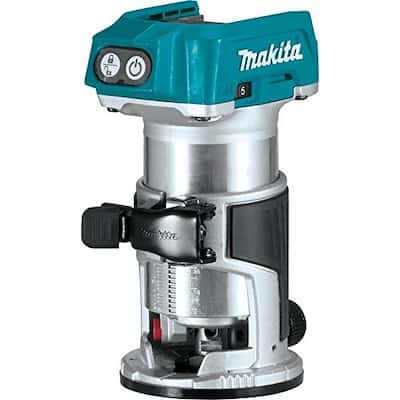
The Makita XTR01Z is a cordless, brushless compact router on Makita's 18V LXT platform. With no cord, it is easier to move around a project. The brushless motor runs longer per charge than a brushed motor. The "Z" means battery and charger are sold separately.
It still packs a punch when it comes to power and speed. Its variable speed setting can go from 10,000 to 30,000 RPM. Controlled by an electronic speed control, you get the exact power and speed you need for the job you are working on.
Pros:
Aside from the fact that it is portable with its cordless function, this unit also boasts of a slim design. It has an ergonomic shape that makes it easier to grip and maneuver on your work table. The rubberized grip comes handy when your hands are sweaty.
You can see your work area easily, thanks to its integrated dual LED lights. You can work even in low-light conditions.
The aluminum housing makes this resistant to impact and external damages.
It handles most edge and trim work you would give a corded compact router.
It can take a dust collection attachment for a shop vacuum.
Run time depends on battery size.
Optional plunge, offset, and tilt bases are available separately.
Cons:
There were those who found this too tall. They also did not like how top-heavy it is.
The Verdict: Which Compact Router Should You Get?
We suggest assessing your preferences and needs first, so you can single out the compact router that best fits your needs.
Most User-Friendly: Bosch Colt Electronic Variable Speed Palm Router. It is easy to set up and use, with steady speed control and a wide speed range.
Packs a Lot of Power: Dewalt DWP611 Variable Speed Compact Router. Its 1-1/4 HP motor handles demanding trim work, and the LEDs, clear base, and 3-year warranty add value.
Most Durable: Makita RT0701 Compact Router. It is sturdily built, with an aluminum motor housing and the widest low-speed range here.
Most Affordable: Enertwist Variable Speed Soft Start Palm Router Kit. It is the cheapest here and still has a cast aluminum housing, soft start, and fine depth adjustment.
Most Portable Choice: Makita XTR01Z Brushless Cordless Compact Router. If you like portability on top of compact functions, get this one from Makita. It is a cordless router that handles most compact-router work without a cord.
Router Safety Basics
Wear eye and hearing protection, and unplug the router before changing bits. Push the bit into the collet until it bottoms out, then pull it out about 1/8 inch before tightening. Clamp the workpiece so both hands stay on the router.
Feed in the right direction. Family Handyman advises running the router counterclockwise around the outside edge so the bit pushes the router toward you, which is easier to control and safer. Go clockwise inside a frame.
For deep cuts, make several shallow passes instead of one deep one.
Conclusion
Find the best woodworking tools that will work for the projects you have lined up. Check out our homepage for the best recommendations on woodworking products out there.
Sources
- Learn the Basics of Using a Wood Router, Family Handyman
- Norm's Notebook: Routers, This Old House