The Best, Most Accurate Angle Finders You Can Buy: Our Top Picks
Contents
- Best Angle Finder Reviews
- 1. GemRed Digital Angle Finder
- 2. Johnson Level & Tool 700 Magnetic Angle Locator
- 3. Wixey WR300 Type 2 Digital Angle Gauge
- 4. General Tools 822 Digital Angle Finder Rule
- 5. Calculated Industries 7434 AccuMaster 2-in-1 Magnetic Digital Level and Angle Finder
- Which Angle Finder Should You Get?
- Conclusion
- Sources
 One of the measuring tools you should always have in your woodworking kit is the angle finder. Angle finders come in several types, from analog dial gauges to digital protractors and magnetic bevel gauges.
For setting saw blades, a digital angle gauge with a stated accuracy of about +/- 0.2 degrees is the most precise option on this list. Here are our recommendations.
Best Angle Finder Reviews
These are the angle finders we recommend:
- GemRed Digital Angle Finder
- Johnson Level & Tool 700 Magnetic Angle Locator
- Wixey WR300 Type 2 Digital Angle Gauge
- General Tools 822 Digital Angle Finder Rule
- Calculated Industries 7434 AccuMaster 2-in-1 Magnetic Digital Level and Angle Finder
Here is what each one does well:
1. GemRed Digital Angle Finder
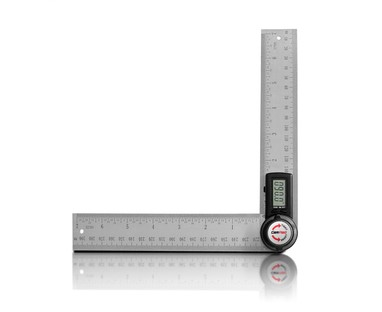
This multi-purpose tool is a digital protractor and a ruler in one. It is compact and easy to use, with two stainless steel ruler arms joined at a hinge that holds a small digital display.
The arms have etched markings for measuring, and the digital readout shows the angle between them. It offers good accuracy for both professional and DIY use. It runs on a lithium coin-cell battery.
Pros:
The stainless steel arms resist wear, and the etched markings are easy to read.
The readings appear on a small digital screen, so you do not have to interpret a dial.
The arms are straight and flat, so they sit well against the surfaces you are measuring.
The hinge locks it in place. With just a simple twist, you can effectively lock it in place.
The zero function is easy to use as well. You can even use it to create odd obtuse or acute angles.
It is affordable for a digital tool.
It folds to a small size, so you can easily stash it in your kit or pocket.
Cons:
Some said the on/off switch is very sensitive. Even just a small movement of the arm sets it on.
2. Johnson Level & Tool 700 Magnetic Angle Locator
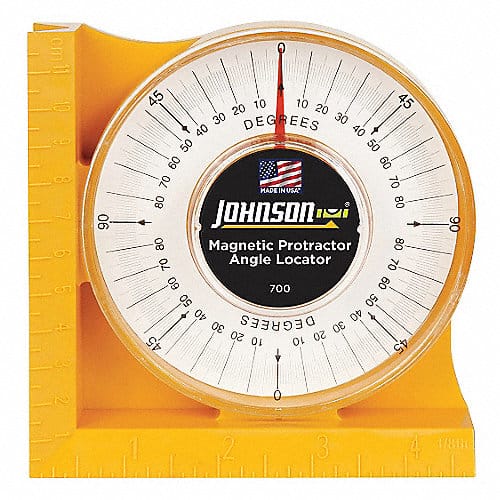
You don’t need to spend a lot of money to find a good angle finder. This analog angle locator reads from 0 to 90 degrees in each quadrant, with the scale printed behind a clear lens.
A magnet in the base holds it on steel surfaces, such as a saw blade, conduit, or ductwork. The molded body stands up to bumps on the job site.
Pros:
Its low price is one of its strongest features.
It is durable. The body is made from an impact-resistant plastic material. You can easily bring it with you and not worry that it will get damaged from all the transport and the usage.
The orange color makes this easier to spot against your other tools.
The magnet holds it in place on ferrous metal, so you can read it hands-free.
You can easily read it. The numbers are large, and the needle is easy to see. As an analog tool, it reads to the nearest degree, so it is less precise than a digital gauge.
This product is compact and lightweight, so it fits easily in a toolbox.
Cons:
There were those who find it too big for their needs.
3. Wixey WR300 Type 2 Digital Angle Gauge
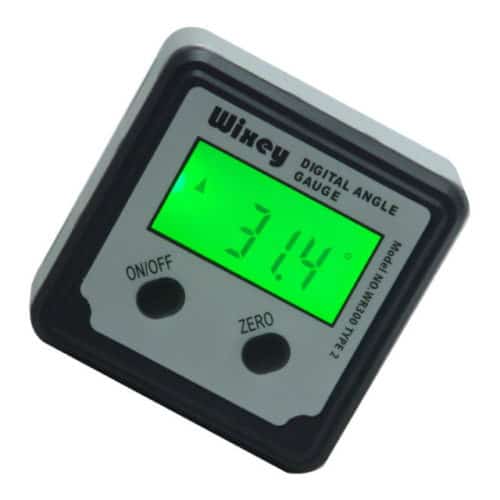
One of the easiest angle finders to use is this one from Wixey. Magnets in the base let it stick to a saw blade or cast iron table. Set it on the table, zero it, then place it on the blade to read the bevel angle relative to the table.
According to Wixey's specifications, it has a range of +/- 180 degrees, 0.1-degree resolution, and +/- 0.2-degree accuracy. It runs on one AAA battery, has a backlight, and shuts off automatically to save the battery.
Always unplug the saw before you put a gauge on the blade, as OSHA advises when adjusting or servicing power tools.
Pros:
This is very easy to use, and zeroing it takes seconds.
It reads quickly, and the screen is easy to read.
It is durable for a small electronic tool. Still, remove it from the blade before you start the saw.
It is compact and lightweight. You can store it in your tool kit easily.
It has a good magnet. You can simply hang it on the blade, and it will allow you to input the angle you want to cut.
The backlit display is also a nice feature. It allows users to see the measurements even in low light conditions.
It makes use of an inexpensive battery. You can also find the battery easily, so if you run out of juice, you should have no problems finding a replacement.
Cons:
There were those who wished it came with a 0.0 reference built in the system.
4. General Tools 822 Digital Angle Finder Rule
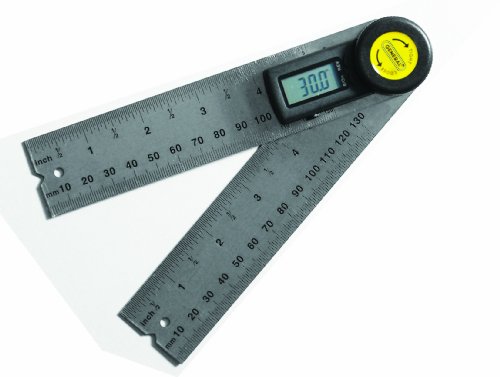
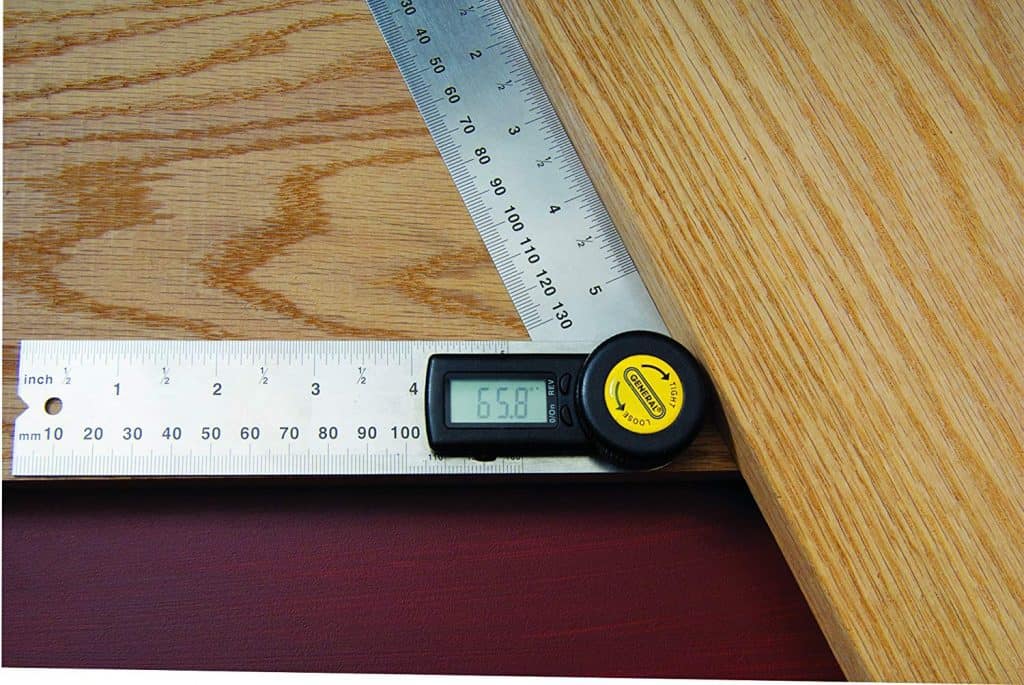
This 5-inch angle finder is a great choice if you want something small. It fits in a pocket or apron. It is a digital stainless steel ruler with a built-in protractor. The LCD display is easy to read, and the hinge swings a full 360 degrees for inside, outside, and reverse angles.
It can be zeroed at any point in the swing, and a lock holds the angle so you can transfer it to your saw.
Pros:
We like the compact features of this angle finder. It is small enough to occupy only a small space in your toolbox but has full-sized functionality.
The LCD display is big enough for easier reading. It also displays accurate readings all the time, thereby eliminating the guesswork.
It is made from stainless steel, which resists rust and scratches.
Using this is easy. Since it measures 360 degrees inside, outside, or in reverse, it offers a lot of flexibility.
It shuts off automatically after a period of inactivity to save the battery.
It is light and easy to handle.
Cons:
The knob protrudes and can get annoying because it gets in the way.
5. Calculated Industries 7434 AccuMaster 2-in-1 Magnetic Digital Level and Angle Finder
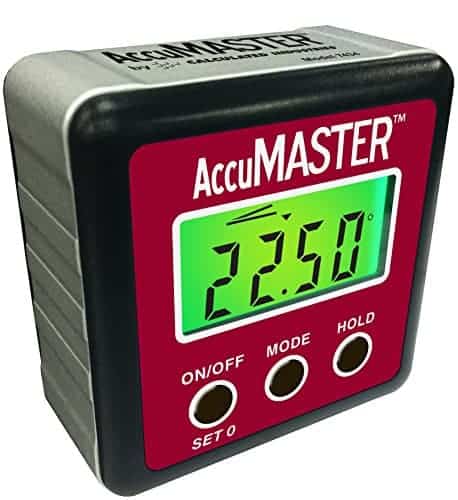
The AccuMaster takes the place of a tilt gage. You can also use this to check the angles found in between surfaces, so if you want to take measurements of a tight spot and other types of angle finders won’t work with such a need, this is a good choice.
This angle finder uses an electronic tilt sensor and has a backlit display for low light. The magnetic base holds it on saw blades and other steel surfaces.
Pros:
This tool is accurate and works in tight spots.
The magnetic base is strong, so it stays put while you adjust a blade.
The backlit screen is easy to read in dim light.
It is built for job-site use, with resistance to dust and splashes. Check the current listing for its exact rating.
It comes with an auto shut off feature. When not in use, it shuts off automatically and allows it to preserve its battery life.
It has a small and compact shape, so storage should not be a problem.
It takes accurate measurements even when turned upside down.
It comes with a storage pouch.
Cons:
It costs more than the other tools on this list.
Which Angle Finder Should You Get?
For Measuring and Transferring Angles: GemRed Digital Angle Finder. Its long stainless arms let you measure an existing corner and read the angle on the digital display. It is a good all-around tool for trim and furniture work.
For People on a Budget: Johnson Level & Tool 700 Magnetic Angle Locator. This is a good choice if you are on a budget. The magnet holds it in place, and it reads to the nearest degree, which is fine for plumbing, conduit, and rough carpentry.
Great for Newbies: Wixey WR300 Type 2 Digital Angle Gauge. If you are new to using an angle finder, this is an easy choice. Zeroing is simple, and its stated +/- 0.2-degree accuracy makes it the most precise option here for setting saw blades.
Most Compact Choice: General Tools 822 Digital Angle Finder Rule. This is the angle finder to get if you want something small. It is shorter than other angle finders with a similar design.
Can Be Used in Tight Spots: Calculated Industries 7434 AccuMaster 2-in-1 Magnetic Digital Level and Angle Finder. If you need an angle finder for tight spots that also works as a small level, get this one. It suits hobbyists and professionals.
Conclusion
For setting blade angles, a digital gauge like the Wixey is the most precise choice. For measuring and transferring angles from existing work, a digital protractor like the GemRed or General 822 is more useful. Check out our homepage for more buying tips as well as product recommendations.