The Best Sander for Removing Paint: Reviews and Ultimate Guide
Contents
Removing paint with a sander takes an aggressive tool, coarse abrasives and good dust control. Paint clogs sandpaper fast, so expect to change discs or belts often.
Check for lead first. If the paint was applied before 1978, it may contain lead, and power sanding it creates hazardous lead dust. Test the paint before you start; see the safety section below.
Here are four sanders that handle lead-free paint removal well.
OUR TOP PICK
The Bosch 1250DEVS is our first choice: a 6-inch random orbit sander with an aggressive turbo mode for stripping and a smoother mode for finishing.
The Best Sanders for Removing Paint Are:
| Product | Details | ||
|---|---|---|---|
| 1. Bosch 1250DEVS | 1. Bosch 1250DEVS Top Pick | - 6-inch pad - 6.5 amps - Corded electric - Two sanding modes | Check Current Price |
| 2. Makita 9903 | 2. Makita 9903 | - 9.5 pounds - 3 x 21-inch belt - 8.8 amps - 690-1,440 ft./min. | Check Current Price |
| 3. Hi-Spec Rotating Disc Palm Sander | 3. Hi-Spec Rotating Disc Palm Sander | - 3.55 pounds - 8 x 6.8 x 5.1 inches - Corded-electric - 2 meters | Check Current Price |
| 4. Porter-Cable Random Orbit Sander | 4. Porter-Cable Random Orbit Sander | - 5-inch pad - 1.9 amps - 12,000 OPM - Corded-electric | Check Current Price |
1. Bosch 1250DEVS - Best Overall
The Bosch 1250DEVS has a 6.5-amp motor, variable speed (listed at 3,100 to 6,650 OPM) and a 6-inch pad. That large pad covers more area than a 5-inch sander.
Its main feature is the dual-mode system. Turbo mode uses an eccentric orbit for fast stock removal, which is what you want for paint. Fine Woodworking found it vibrates enough in turbo that you need both hands, while the random orbit mode runs much smoother for finishing.
Constant response circuitry helps hold speed under load, and a pad brake helps prevent gouges and swirl marks when you set the sander down. Hook it to a vacuum for dust control.
Bosch has since replaced it with the GET75-6N, so you may find the newer model in stores.
Specs
- 6-inch pad
- 6.5 amps
- Corded electric
- Turbo and random orbit modes
Pros
- Large panels in the pad that make dust collection efficient
- Turbo mode removes paint fast
- Sturdily constructed using die-cast aluminum for a longer lifespan
Cons
- Vibrates in turbo mode and needs two hands
2. Makita 9903 - Runner-Up
The Makita 9903 is a 3 x 21-inch belt sander with an 8.8-amp motor. A belt sander removes paint faster than any orbital sander on flat surfaces such as doors, tabletops and deck boards.
Its auto-tracking system keeps the belt centered without constant adjustment. It sands flush to a wall with its nose and side.
A variable speed dial runs the belt from 690 to 1,440 feet per minute. Slower speeds help keep paint from heating up and gumming the belt. Makita says it sands wood or metal and removes paint and rust.
Specs
- 9.5 pounds
- 3 x 21-inch belt
- Corded electric
- 690-1,440 ft./min. variable speed
Pros
- Long 16.4-foot cord
- Designed with a dust bag to make your workplace mess-free
- Can be used for removing paint from both wood and metal
Cons
- Belt sanders gouge easily if tilted or held in one spot
3. Hi-Spec Rotating Disc Palm Sander
The Hi-Spec palm sander is a light, budget random orbit sander with a 240-watt motor. It comes with a starter set of hook-and-loop discs from coarse to fine.
Rubberized grips make it easy to hold. It is best for small paint-removal jobs such as furniture and trim, not large surfaces, since a small, low-powered sander removes paint slowly.
Specs
- 3.55 pounds
- 8 x 6.8 x 5.1 inches
- Corded-electric
- 2 meters
Pros
- 240-watt motor
- Comes with reusable dust collectors
- Light-weight
Cons
- Short 2-meter cord
- Slow on large painted areas
4. Porter-Cable Random Orbit Sander
The Porter-Cable 382 is a compact 5-inch random orbit sander with a 1.9-amp motor running at a fixed 12,000 OPM. It is light, so it suits vertical surfaces and long sessions.
With 1.9 amps it removes paint more slowly than the Bosch or the Makita belt sander. It is best for smoothing after the bulk of the paint is gone.
Check Porter-Cable for current warranty terms; the brand has historically offered a three-year limited warranty on its power tools.
Specs
- 5-inch pad
- 1.9 amps, 12,000 OPM
- Corded-electric
- Light and compact
Pros
- Compact and light
- Equipped with a dual-plane counterbalance system for reducing user fatigue
- Uses a sealed ball-bearing construction for enhancing durability
Cons
- The power cord can at times gets on your way when sanding
Buying Guide
Lead Paint Safety
In homes built before 1978, assume old paint may contain lead until a test shows otherwise. EPA notes that disturbing old paint can create large amounts of lead dust, and it advises fixing small areas without sanding, or wetting the surface first if you must sand.
If the paint tests positive, do not dry power-sand it. Use wet methods or a chemical stripper, or hire a lead-safe certified firm. Under EPA's Renovation, Repair and Painting rule, anyone paid to disturb paint in a pre-1978 home must be certified.
Choosing a Sander
Belt sanders are recommended when you are targeting high-efficiency on large flat surfaces. Random orbit sanders are slower but easier to control and leave a smoother surface. For thick paint on detailed trim, a chemical stripper or heat gun often works better than any sander.
Other factors to consider when buying a sander for removing paint include:
Power
Different sanders come with varying power levels. For paint removal, more power keeps the pad or belt from bogging down under coarse grits.
Speed
Variable speed helps with paint. Lower speeds reduce heat, which keeps soft paint from melting and gumming up the abrasive.
Ease of Use
Paint clogs abrasives quickly. Hook-and-loop discs and quick-release belt levers make frequent changes painless.
Dust Management
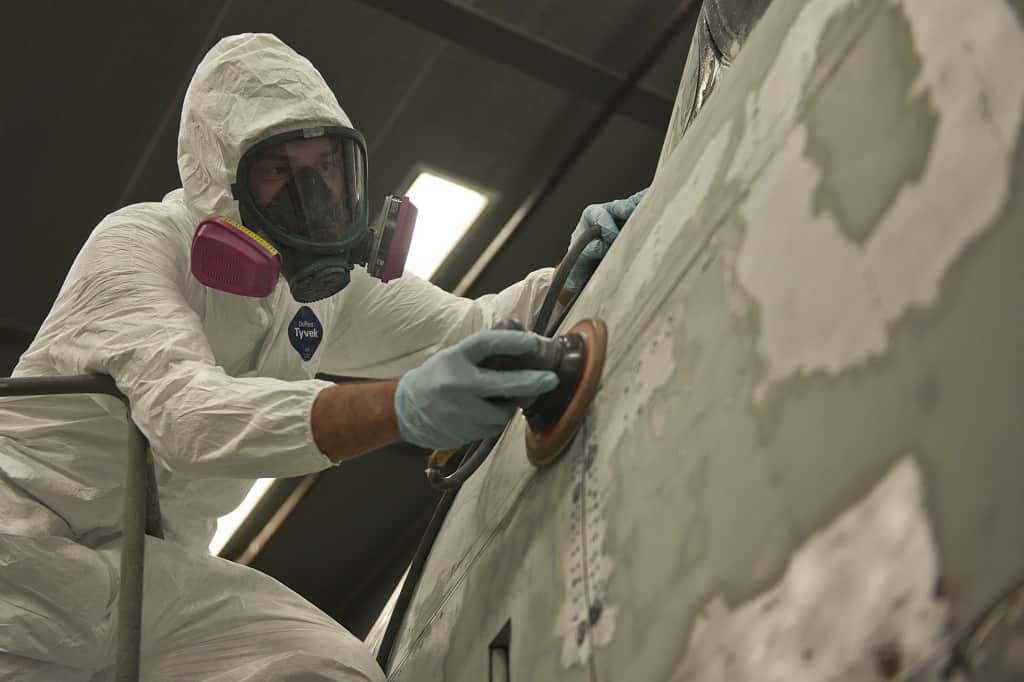
Paint dust is messy and can be harmful. Choose a sander with a dust port that connects to a shop vacuum so it catches the bulk of the particulates, and wear a respirator and eye protection.
Ergonomics
Paint removal takes time. A comfortable grip and low vibration let you work longer with better control.
Final Thoughts
Test for lead first, then match the sander to the surface: a belt sander for large flat areas, a random orbit sander for smoothing and smaller parts.
Our top pick is Bosch 1250DEVS for its large pad and aggressive turbo mode, which strip paint quickly and then switch to smoother finish sanding.
Sources
- Protect Your Family from Sources of Lead, US EPA
- Lead Renovation, Repair and Painting Program, US EPA
- 9903 3 in. x 21 in. Belt Sander, Makita
- Bosch 1250DEVS 6-in. Random Orbit Sander review, Fine Woodworking