Select Better Wood by Knowing Its Grain
 When you're choosing wood for a project, grain is one of the most useful things to understand. It affects strength, how the board machines, and how it takes a finish.
Grain describes the direction and pattern of the wood fibers. Each board is unique, but there are 6 common types of grain you'll run into.
- Straight Grain. The fibers run parallel to the length of the board. It is the easiest grain to work and the most predictable in strength.
- Irregular Grain. The fibers wander instead of running straight, often around knots. Expect more tear-out when planing.
- Diagonal Grain. This happens when a straight-grained log is sawn at an angle to its axis, so the fibers run out through the face of the board. It weakens the board compared with straight grain.
- Spiral Grain. The fibers wind around the trunk because the tree twisted as it grew. Lumber with strong spiral grain tends to twist as it dries, so most woodworkers avoid it for structural parts.
- Interlocked Grain. The spiral direction reverses in successive growth layers. It creates a ribbon figure on quartersawn faces and is prone to tear-out.
- Wavy Grain. The fibers form regular waves, which create figure like curly or fiddleback maple. Unlike irregular grain, it is consistent and usually free of knots.
Why Is Knowing Your Wood Grain So Important?
Knowing the grain of your wood helps you get the most from it, and it also matters when you select the right wood flooring for your home.
For structural parts, such as legs, rails and shelves, straight grain is the safest choice. Grain that runs out of the board at an angle lowers its strength.
Figured or irregular grain is better saved for panels and tops. If you're machining it, take light passes with sharp blades to limit tear-out.
 Is Your Wood Open-Grained or Closed-Grained?
Once you know the grain pattern, check whether the wood is open-grained or closed-grained. This describes the size of the pores you can see on the surface.
Open-grained woods have visible pores. Oak, ash and hickory are common examples.
Closed-grained woods such as maple, walnut and cherry have pores too small to see with the naked eye. They finish smoothly with less work.
Softwoods like pine don't have pores at all, so pore filling isn't a concern with them.
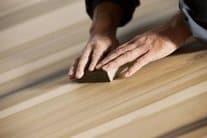
Why is this important? If you want a smooth, glass-like finish on an open-grained wood, you'll need to fill the pores of the grain with a filler or with built-up coats of finish.
Red oak is a good example. Its pores are wide open, so you can blow air through the end grain of a short piece.
White oak looks similar, but its pores are plugged with cells called tyloses. That blocks water from passing through, which is why white oak is used for barrels and outdoor furniture, and red oak is not.
How to Properly Fill Wood Grain
There are three common ways to fill pores:
- Paste wood filler. Work the filler into the pores across the grain, then wipe or sand off the excess. Oil-based fillers are easier to control than water-based ones, which dry fast.
- Build up the finish. Apply enough coats of finish to fill the pores, then sand the surface level before the final coats.
- Oil slurry. Wet-sand an oil finish into the wood. The sanding dust mixes with the oil and partly fills the pores.
Boiled linseed oil works well for a slurry and brings out the grain. Let filler and finish cure fully before topcoating.
Safety: rags soaked in linseed oil and other oil finishes can catch fire on their own as they cure. Spread them flat or hang them outdoors until fully dry before you throw them away.
Knowing the grain of wood helps you choose the right board, work it without tear-out, and fill the pores when you need a smooth finish.
We're really proud of our site here at Woodwork Nation and thanks for reading, you can read more product related reviews here if you're in the market to expand your woodworking tool set.
Sources
- Open-grain vs. closed-grain wood, Fine Woodworking
- Filling Pores, Fine Woodworking
- Boiled linseed oil, Fine Woodworking