Radial Arm Saw vs Table Saw: Which One is More Useful and Why?
Contents
- Radial Arm Saw vs Table Saw: Product Reviews
- 1. SawStop 10-Inch Professional Cabinet Saw
- 2. Original Saw Company 12-Inch Contractor Duty Radial Arm Saw
- Radial Arm Saw Vs Table Saw: What You Need To Know
- Uses Of The Table Saw
- Uses Of The Radial Arm Saw
- Radial Arm Saw vs Table Saw: The Top Brands
- Conclusion
- Sources
Have radial arm saws become obsolete? It is a fair question, since compound miter saws have taken over most crosscutting for casual users. Miter saws take up less space and are easier to use safely.
Radial arm saws are still made, mostly for production shops. Older home models could also take accessories for routing, sanding, and shaping. Their strength is crosscutting long, wide, or rough boards.
Table saws are the better tool for ripping boards and cutting sheet goods to size. With jigs and accessories, they also cut accurate joinery such as tenons, dados, and box joints.
Let’s look at the differences between these two types of saws to help you decide which is the best option for you.
OUR TOP PICK
For most woodworkers, we recommend a table saw over a radial arm saw, specifically the SawStop 10-inch 1.75HP Cabinet Saw. It is a heavy-duty cabinet saw that handles large stock and accurate joinery. Its flesh-sensing brake is the main reason we pick it, and its cast iron and steel build suits professional work.
Radial Arm Saw vs Table Saw: Product Reviews
| Product | Details | ||
|---|---|---|---|
| 1. SawStop 10-Inch Professional Cabinet Saw | 1. SawStop 10-Inch Professional Cabinet Saw Top Pick | - 1.75 Horsepower motor - 36-inch T-Glide Fence and Rail - 10-inch blade diameter - Shroud and Dust Collection Blade Guard | Check Current Price |
| 2. Original Saw Company 12-Inch Contractor Duty Radial Arm Saw | 2. Original Saw Company 12-Inch Contractor Duty Radial Arm Saw | - 3HP single-phase 208/220V TEFC motor - 24-inch crosscut - 32-inch height standard worktable - Heavy gauge steel frame and legs | Check Current Price |
1. SawStop 10-Inch Professional Cabinet Saw
The 10-inch 1.75HP Professional Cabinet Saw has a 36-inch T-Glide fence and rail system made of heavy gauge steel. The trunnion and arbor are solid, and gas-piston-assisted elevation makes blade height easy to adjust.
Its best-known feature is SawStop's safety system. It senses when skin touches the spinning blade and stops the blade within milliseconds, then drops it below the table.
The brake has prevented many serious hand injuries, though it does not replace the blade guard, riving knife, and push sticks. A blade shroud and dust collection guard capture most of the dust when connected to a dust collector.
Specs
- 1.75 Horsepower motor
- 36-inch T-Glide Fence and Rail
- 10-inch blade diameter
- Shroud and Dust Collection Blade Guard
Pros
- Dust collection blade guard and shroud capture most of the dust
- A true vertical elevation with a gas piston assist for smooth and easy adjusting
- Features the SawStop patented safety system that stops the blade within milliseconds of skin contact
Cons
- Some users have had alignment issues with the blade and the fence
2. Original Saw Company 12-Inch Contractor Duty Radial Arm Saw
The 12-Inch Contractor Duty Radial Arm Saw is a heavy-duty saw built for production crosscutting. It suits small shops that build cabinets, shelves, doors, and similar work.
It makes crosscuts, miters, and bevel cuts with repeatable accuracy.
Check the current specifications and assembly details with Original Saw Company or a dealer before you buy, since models and options change.
Specs
- 3HP single-phase 208/220V TEFC motor
- 24-inch crosscut
- 32-inch height standard worktable
- Heavy gauge steel frame and legs
Pros
- Powder-coated heavy gauge steel frame and legs
- Features an automatic blade braking system
- Precise and accurate cuts every time
- Stable cutting surface with minimal vibrations
Cons
- Has a higher risk of injury than a table saw
Radial Arm Saw Vs Table Saw: What You Need To Know
Both saws cut wood on a table surface. The difference is where the blade sits and how it meets the wood. On a table saw, you push the wood into a fixed blade. On a radial arm saw, the wood stays still for crosscuts and you pull the blade across it. The radial arm saw is credited to Raymond DeWalt in the 1920s.
While they are both very instrumental in woodworking, they each have certain advantages over each other. Let’s look at some of these in more detail.
Uses Of The Table Saw
The table saw features a circular blade that protrudes through the table from underneath. The depth of the cut on the wood is made by the blade moving up through the table.
You push the board past the spinning blade, guided by the rip fence or a miter gauge. It makes rip cuts along the grain and crosscuts, and the blade tilts for bevel cuts up to 45 degrees.
Use the blade guard and riving knife, and use a push stick for narrow rips. Kickback, when the blade throws the board back at you, is a leading cause of table saw injuries.
Pros
- It is easy to use because the table surface is sturdy and the blade is fixed.
- It allows for large pieces of wood or board to be cut smoothly and accurately
- It allows for more precise cuts by use of accessories such as jigs
- It has fewer setup changes between cuts, which makes it simpler to learn
Cons
- It needs room in front and behind the blade for long rips.
- Since the blade is fixed, you have to move the board through the cut
- Crosscutting very long boards is awkward
Uses Of The Radial Arm Saw
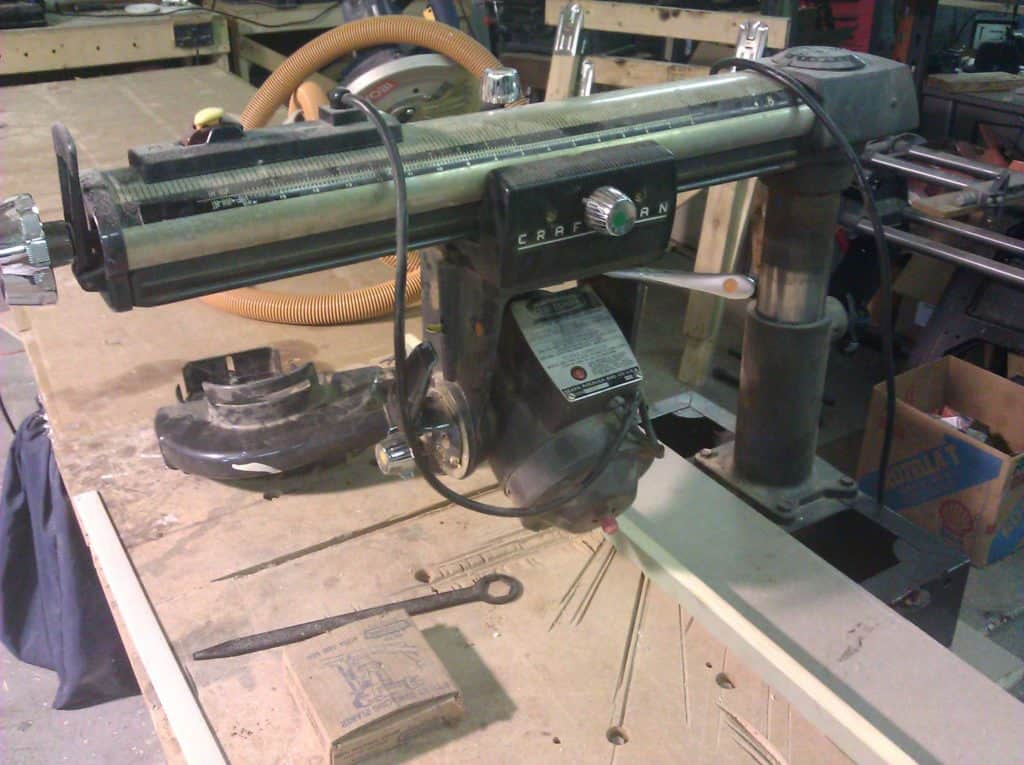
The radial arm saw has a blade mounted on a motor carriage that slides along an arm above the table. You pull the saw across the board to make crosscuts. The arm swings for miters, the motor tilts for bevels, and the motor can be rotated for ripping, so it makes many types of cuts.
Pros
- It allows for making a wide range of miter cuts and decorative cuts
- It is easier to crosscut long, heavy boards because the board stays still
- It can sit against a wall, with long tables on each side for lumber
Cons
- The blade can climb toward you during a crosscut, and ripping carries a serious kickback risk
- Ripping wide sheet goods is awkward and limited by the arm's reach
- New industrial models are expensive, and parts for old home models can be hard to find
Radial Arm Saw vs Table Saw: The Top Brands
The radial arm saw and the table saw are both heavy-duty machines for cutting a variety of construction materials apart from wood. Before we review the individual machine, let us briefly review two of the top brands that produce them.
Original Saw Company is one of the few companies that still makes radial arm saws.

The company builds industrial radial arm saws that trace their design back to the original DeWalt radial arm saw.
It also makes cut-off saws, beam saws, and accessories. Its radial arm saw line ranges from the 12-inch Contractor Duty model to large heavy-duty saws.
These radial arm saws make crosscuts, compound miters, bevels, and dados.
Some of the features you can expect to find on their radial arm saws include:
- Fan-cooled motors with a blade brake
- Heavy cast and steel construction for a stable cutting surface
- Controls that keep the saw from restarting by itself after a power interruption
- Lower blade guards
SawStop is one of the best-known cabinet saw brands in the United States, sold through dealers across the country.

The brand is built around its flesh-sensing blade brake.
Table saws still cause tens of thousands of blade-contact injuries each year. The U.S. Consumer Product Safety Commission's 2019 table saw update found no drop in those injuries after blade guard requirements were added to the voluntary standard. That is why SawStop focuses on technology that can enhance safety.
The brake can stop a spinning blade within milliseconds of skin contact, which can turn a potential amputation into a minor cut.
Here are some specific features that you can find across their table saw product catalog:
- SawStop safety system that includes an electronic detection unit and a fast-acting brake that stops the blade within milliseconds when contact is detected.
- Cast iron and steel construction provides a more rigid and stable machine.
- Saws are designed for accurate alignment with minimal setup.
Conclusion
So, are radial arm saws obsolete? Not completely, though few companies still make them.
The 12-Inch Contractor Duty Radial Arm Saw from Original Saw Company is a good example of the industrial-sized radial arm saws still made today. It makes sense for shops that crosscut a lot of long lumber.
For most woodworkers, a table saw is the more useful machine. We recommend the 10-inch 1.75HP Professional Cabinet Saw. It rips and cuts sheet goods accurately, and its blade brake is one of the best safety systems on the market. Pair it with a miter saw or crosscut sled for crosscuts.
Sources
- Table Saw Update 2019, U.S. Consumer Product Safety Commission
- 1910.213: Woodworking machinery requirements, OSHA